
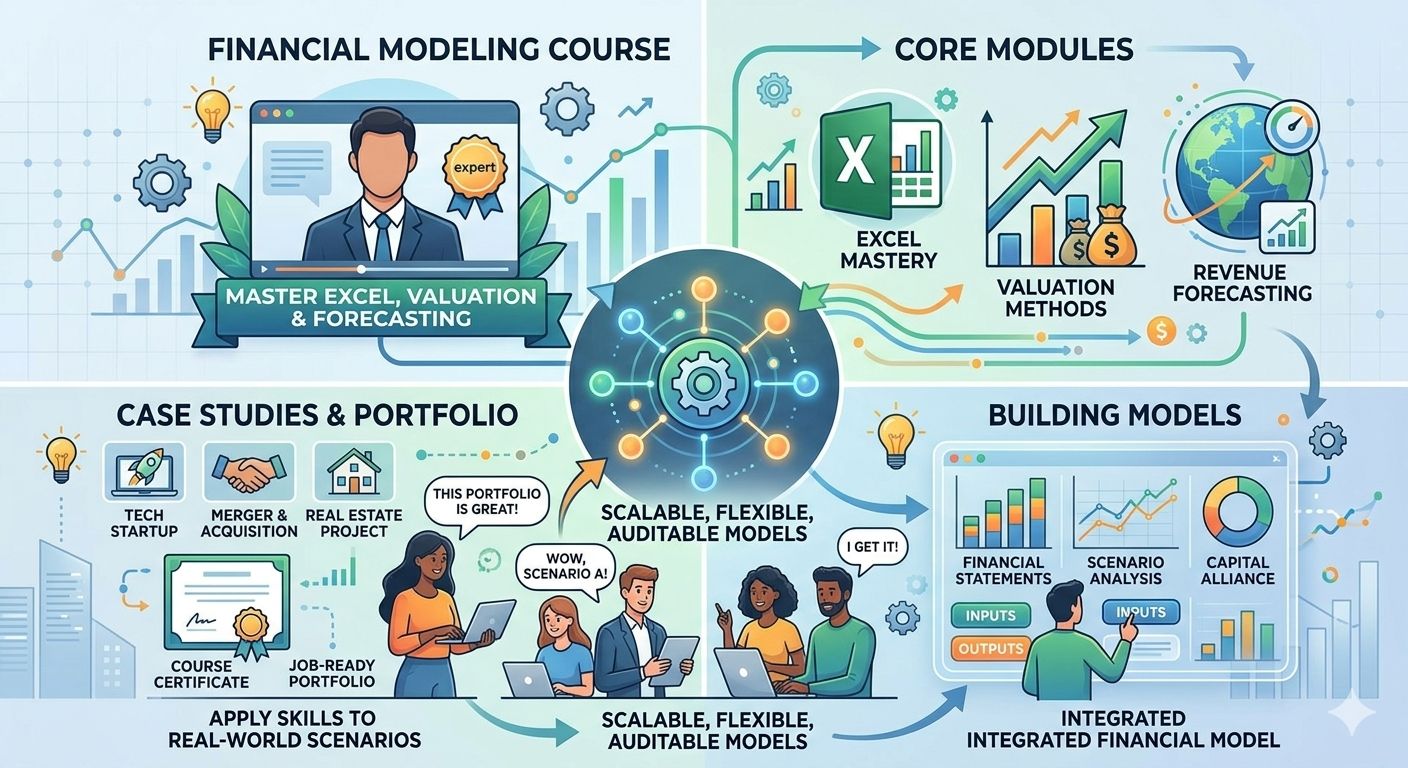
Learn about a Financial Modeling Course to build skills in financial analysis, forecasting, valuation, Excel, and practical modeling for career growth in finance.
Financial modeling is essentially a course in writing spreadsheets that are capable of forecasting a company's future financial figures, such as its revenue, profit and cash flow. That's the short answer. Most useful skill you can learn for a finance career.
This blog will take you through what you will learn, why it matters and how a dedicated financial analyst course in pune can help you carry these skills to your real job.
The Importance of the Financial Modeling Course
Data cannot tell a whole story on its own. A great model takes raw data into a beautiful vision of the direction in which your business is heading. This is precisely why a complete financial modeling course has emerged to be one of the highly sought-after skills in the domain of finance today.
This is what makes this skill so important here:
- This will also assist you in forecasting both revenues and costs.
- This feature is applicable across almost every finance job - banking, startups and beyond
- This will indicate the ability to convert numbers into actionable insight that an employer is looking for
- It helps you gain confidence for interviews as well as work tasks in the real world
What Will You Learn from A Typical Course
Beginner friendly programs usually follow a simple step-by-step process.
- You have expert on Excel basics – Formulas, shortcuts, Clean formatting
- For this, you need to construct a three-statement model–income statement, balance sheet and cash flow
- Forecast – A prediction of the numbers of the future based on previous data
- Valuation basics – Valuing what might a company be worth
- Scenario analysis – Analyzing a "what if" scenario where sales are slower
This step-by-step approach prevents beginners from becoming overwhelmed at the outset.
Why Excel Skills Come First
Most courses dedicate actual time on Excel fundamentals before constructing entire models.
- A robust shortcut knowledge is time-saving at later stages
- Models are easier to read and check with clean formats
CRUD: The Simple Part of Every Model You'll Ever Build
- Practice Established Habits Early Will Prevent Messy Error-Prone Excel Spreadsheets
It is sometimes a step that falls by the wayside, but this practice time pays off as most problems happen when this stage is skipped.
Building Your First Simple Model
You will often start out small before you attempt a whole company model as the main structure of your design.
- Begin with an annual revenue projection for a single product
- Add simple cost assumptions
- Calculate profit step by step
- Gradually developed into a comprehensive three-statement model
Slow and steady that builds true confidence over confusion.
All About Practice — : This Is Why It Doesn’t Matter Which Theory You Have.
Videos are no more than one of the ingredients out there. Having Real Hands on Practice in Financial Modeling courses**
- Not just following along, but building the models from scratch
- Using actual / realistic company data
- Learning how to fix things instead of watching them be fixed
- Reviewing completed models for accuracy
It is this participatory mechanism that tends to distinguish the self-assured learner from the theoretical one.
Skills To Set You Apart
Other than technical skills, there are also a few soft skills which helps you to stand out in interviews as well as on the job.
- Attention to detail as small mistakes can corrupt an entire model.
- The transparency of communication when you are clarifying your assumptions
- Comfort working under tight deadlines
- An inquisitiveness about the fundamentals of how businesses earn money
Common career paths that heavily employ Financial Modeling
This skill unlocks a very wide array of roles.
- Financial Analyst
- Investment Banking Analyst
- Equity Research Associate
- Corporate Finance Executive
- Startup Finance Roles
But How to Turn Skills Into a REAL Job
Acquiring that skill is only part of the journey. Most learners pursue a specialized finance analyst course in pune, which further bridges imaginary classroom teachings to practical job scenarios.
- Practice with real-world case studies
- Have a portfolio of example models to showcase for employers
- Get constructive criticism from industry mentors
- Interviews directly test your modeling skills
How to Select The Best Course For You
Of course, not every program is that useful, a little bit of research goes a long way.
- Make sure the training involves live projects and is not purely lecture based
- Seek Instructors With Actual Work Experience
- This is true for you simply by employing words {that are| with respect to} reactions from past students (with a significant distance making)
- Deep : Compare course length against actual depth of content
Common Mistakes Beginners Make
- Elephant in the room: Jumping into complex models without learning simple Excel tricks
- Overusing templates without grasping the logical basis behind them
- Omitting the formatting that makes models impossible to read
- Skipping practice and only watching tutorials
Frequently Asked Questions
Do I need to have a background in advanced maths before getting started?
No, basic arithmetic and logical thinking is typically sufficient to get started.
Q: How much time is required to learn financial modelling?
Generally beginners can build simple models within a matter of weeks, full confidence in their capabilities generally comes with some months of practice.
I have data upto October 2023, is Excel enough or I need some other software?
Excel is still the key tool for most work at a beginner and intermediate level, although some advanced roles use other software in addition over time.
And this is why you will not be placed in a job straight after taking this course.
It provides a solid base, but if you complement it with actual practice and a portfolio, your chances are significantly higher.
Final Thoughts
A financial modeling course keeps you one of the most practical, sought after skills in finance world who translate thee raw numbers into real business insight. Combining this soft-skills with a specialized career-building financial analyst course in pune can enable you to bridge the gap between theoretical & practical knowledge, if done right, of course. In that way you will go from being a self-learner (imagine going from 0–10) to being confident as an industry-ready professional.